Does Your Name Affect Your Love Life? What the Research Really Says
Numerology charts, baby-name forums, the classic FLAMES game, and every love calculator on the internet share one idea: the letters in your name say something about your romantic future. Psychologists have actually tested pieces of that idea for 40 years. Some findings held up, some fell apart, and one famous result is still being argued about. Here’s the honest version.
⚡ Key Takeaways
Your name has a small, real effect on first impressions and almost no proven effect on how your love life turns out. People reliably like the letters in their own name (the name-letter effect), and studies show names can change how many people click on a dating profile. But the famous claim that we marry people with similar names was challenged in 2011 as a statistical artifact, and nothing links a name, a numerology number, or a calculator score to whether a relationship lasts.

Two Very Different Questions Hiding in One
When someone types “does your name affect your love life” into Google, they’re usually asking one of two things.
The mystical question: Does my name carry a vibration, a destiny number, or a cosmic match with someone else’s name? That’s the territory of numerology, name astrology, and a lot of fun online tools.
The psychological question: Does my name change how people react to me, or quietly nudge who I’m drawn to? That one can be tested with data, and researchers have tested it.
We’ll take the science first, then the traditions, then the calculators. Spoiler for the impatient: the mystical version has no evidence behind it, and the psychological version is real but much smaller than most articles make it sound.
The Name-Letter Effect: The Part That Holds Up
In 1985, Belgian psychologist Jozef Nuttin published a strange little finding. When people were shown letters and asked which ones they liked, they picked the letters from their own name more often than other people did, even when they didn’t realize their name had anything to do with the task. He called it the name-letter effect and described it, cheekily, as “narcissism beyond Gestalt and awareness” (Nuttin, 1985, European Journal of Social Psychology).
This one has aged well. Nuttin followed up with studies in twelve European languages, and later researchers found the same pattern in the Greek, Cyrillic, Thai, and Japanese hiragana writing systems. A detailed review by Vera Hoorens of the University of Leuven notes that a meta-analysis found no trace of publication bias in this literature, that the preference is usually strongest for initials, and that it shows up from schoolchildren to older adults (Hoorens, European Review of Social Psychology).
The same review describes a study by Stieger and LeBel (2012) of people who took a new surname at marriage. They still preferred the initial of their birth name decades later. Your name letters stick with you, even after the wedding certificate says otherwise.
The effect is so dependable that psychologists use letter preferences as an indirect measure of self-esteem. That’s the key to reading it correctly: the name-letter effect is about liking things linked to “me.” It is not, on its own, evidence that names steer romance. That bigger leap came next.
Implicit Egotism: From Liking Letters to Choosing Partners
In the early 2000s, Brett Pelham, Matthew Mirenberg, and John Jones proposed implicit egotism: if we automatically like things associated with ourselves, maybe that tug shows up in big life choices. In ten studies they reported that people were overrepresented in places and careers resembling their names, the famous “Dennis the dentist” and “Louis in St. Louis” examples (Pelham, Mirenberg & Jones, 2002).
Then they turned to love. In a 2004 paper with the irresistible title “How Do I Love Thee? Let Me Count the Js,” Jones and colleagues reported four archival studies of marriage records showing that people were disproportionately likely to marry someone whose first or last name resembled their own (Jones, Pelham, Carvallo & Mirenberg, 2004).
The same paper included lab experiments, which are the more convincing half. Participants felt more attracted to a stranger when:
- the stranger’s arbitrary code number happened to match the participant’s birthday,
- the stranger’s surname shared letters with the participant’s own, or
- the stranger’s jersey number had been subliminally paired with the participant’s name.
That’s a tidy story: familiar equals comfortable, comfortable equals a little more attractive. If it ended there, the answer to “does your name affect your love life” would be a confident yes. It didn’t end there.
The Plot Twist: “Spurious?”
In 2011, Uri Simonsohn of the Wharton School published a reanalysis in the same journal, titled simply “Spurious?” He was able to replicate the original marriage, job, and moving patterns, but argued they were most likely produced by cohort, geographic, and ethnic confounds, plus reverse causality, rather than by people unconsciously preferring their own letters (Simonsohn, 2011, Journal of Personality and Social Psychology).
Here’s what that means in plain English for the marriage data:
- Cohort: Names go in and out of fashion. Two people born in the same era are more likely to share name features simply because they got names from the same popularity wave, and people tend to marry within their age group.
- Ethnicity and community: Surnames cluster by heritage, and people often marry within their community. Economist Tim Harford, summarizing Simonsohn’s work, points out that more than 200 same-surname marriages in his data came from just four names: Patel, Nguyen, Tran, and Kim. That’s not letter-love. That’s people marrying within immigrant communities (Harford, 2016).
- Small baselines: Same-name marriages are rare, so a handful of oddities (remarriages to the same person, clerical errors) can tip the statistics.
Pelham and Carvallo replied that Simonsohn’s own tests were often too statistically weak to detect a real effect, and that there’s no strong theoretical reason the effect should exist only in the lab (Pelham & Carvallo, 2011). They later published new census-based analyses that tried to control for gender, ethnicity, and education. The debate hasn’t been fully settled, and Hoorens’ review, written by a name-letter specialist, explicitly calls the real-world-decisions literature “controversial.”
⚖️ Where That Leaves Us
Liking your own letters: well established. Feeling a flicker of extra warmth toward a stranger who shares your birthday or initials, in a lab: supported. Actually marrying someone because of a name match: unproven and seriously disputed. If any real-world effect exists, it’s tiny compared with age, location, culture, and plain old personality.
First Impressions: What Your Name Signals Before You Say Hi
The stronger evidence for names mattering in romance isn’t about which letters you like. It’s about how other people react to your name before they know anything else about you.
Jochen Gebauer, Mark Leary, and Wiebke Neberich analyzed users of the German dating site eDarling across three studies (968, 4,070, and 6,775 people). On that platform, users initially saw only a first name, age, and region before deciding whether to click a profile. In all three studies, people with less-liked names received fewer first visits (Gebauer, Leary & Neberich, 2012). The University of Mannheim’s summary says some less favorable names were clicked as little as half as often, comparing names like Alexander and Julia with Kevin and Chantal (University of Mannheim).
That’s a real, measurable effect on dating, but read it carefully. The study was in Germany, where names like Kevin and Chantal carry specific stereotypes, so the findings don’t translate directly to other countries. And the people with less-liked names also reported lower self-esteem, more smoking, and less education on average. The authors argue that a lifetime of small rejections plays a part. A simpler explanation is also possible: in many places, first names hint at social class, and class is linked to all of those outcomes. The study can’t fully separate the two.
Simon Laham, Peter Koval, and Adam Alter found across five studies that people with easier-to-pronounce names were judged more favorably, and that the effect held after accounting for how long, unusual, or foreign-sounding a name was. In a field study of around 500 US lawyers, those with more pronounceable names held higher positions in their firms (NYU Stern summary of Laham, Koval & Alter, 2012).
That research wasn’t about dating, so we can’t say it changes your match rate. But the mechanism, called processing fluency, is general: things that feel easy to process tend to feel a bit more pleasant. It’s reasonable to expect a mild version of the same snap judgment when someone glances at a dating profile. “Mild” is the important word.

6 Realistic Ways Your Name Touches Your Love Life
So if destiny is out, what’s left? Here’s what the evidence and common sense actually support, from most solid to most speculative.
It Shapes the Very First Glance
On apps and sites where people see your name before anything else, the name feeds a split-second judgment. The eDarling data shows that judgment can affect whether someone even opens your profile. Once people see photos, read a bio, or start a conversation, other information quickly takes over.
Pronunciation Adds a Little Friction (or Doesn’t)
An easy-to-say name removes a tiny moment of hesitation. A less familiar name might add one. That’s an unfair bias, not a reflection of you. One small fix: people often avoid saying a name they’re unsure how to pronounce, so a quick “it’s pronounced…” on a profile or at a first meeting lowers the barrier.
A Faint Familiarity Tug
The lab work on implicit egotism suggests that sharing initials or a birthday can add a whisper of warmth toward a stranger. Notice the word whisper. Nobody has shown that this tilts real dating decisions in a meaningful way, and the marriage-record evidence is disputed. Treat it as a fun conversation starter (“Wait, we have the same initials!”), not a sign from the universe.
It Signals Culture and Community
Names often carry clues about language, religion, region, and family heritage. Many people prefer partners who share their background, and names can act as an early shorthand for that. This is exactly the pattern Simonsohn argued explains the same-surname marriages: it’s not the letters doing the work, it’s the community behind them.
Nicknames Become a Private Language
This is where names get genuinely sweet. Couples often invent pet names and in-jokes that nobody else understands. Communication researcher Carol Bruess studied this kind of private couple language with Judy Pearson in 1993 and reported that couples who used personal nicknames and terms of endearment tended to have happier marriages (Bruess, TEDx). That’s a correlation: happy couples probably make up more pet names, rather than pet names creating happiness. Still, it’s the one name effect you actually get to choose.
The Stories You Tell Yourself
If you grow up believing your name is lucky, or that a certain number or letter “matches” yours, that belief can color how you read a new relationship. You might notice the signs that confirm it and overlook the ones that don’t. Psychologists call that confirmation bias. Nobody has measured this for names and romance specifically, so take it as a reasonable caution rather than a finding.
Myth vs. Evidence: A Quick Reference
Here’s every popular claim about names and love we could find, rated against what the research actually shows.
| Claim | What the evidence says |
|---|---|
| People like the letters in their own name | Well supported Replicated across many languages and alphabets for 40 years. |
| You’ll be more attracted to someone who shares your initials | Weak, lab only Small effects in experiments with strangers. Not shown to drive real dating choices. |
| People marry partners with similar names | Disputed Reported in marriage records (2004), then attributed to age, ethnic, and regional confounds (2011). Still debated. |
| Your name affects how many people check out your dating profile | Supported in one large dataset German eDarling users with less-liked names got fewer first clicks. Effect is culture-specific. |
| Easy-to-pronounce names make better first impressions | Supported (outside dating) Shown for general likability and workplace status. Not tested directly on romance. |
| Name numerology reveals your soulmate | No evidence A belief system, not a scientific claim. No study links name numbers to relationship outcomes. |
| A love calculator score predicts if you’ll last | No evidence It’s math on letters, designed for fun. Same names, same score, whatever your real chemistry. |
| Changing your name will improve your love life | No evidence Any first-click effect is tiny next to how you actually show up in a relationship. |
Names and Fate: What Different Traditions Believe
Long before psychology labs existed, cultures around the world tied names to fortune. These are worth knowing about because they shape how millions of people think about names and love. To be clear up front: these are belief traditions and cultural practices, not scientific findings.
Western name numerology
Modern numerology assigns each letter a number (a common system maps A to 1, B to 2, and so on, cycling through 1–9), adds the digits of your name, and reduces the total to a single “destiny” or “expression” number. Compatibility readings then compare two people’s numbers. It traces its philosophy loosely to the ancient Pythagorean idea that numbers underlie everything. Different systems give different numbers for the same name, which tells you something about how precise it is.
Hindu naming customs
In many Hindu families, a baby is named in a ceremony called namakarana, often around the tenth or twelfth day after birth. In astrological traditions, the name is chosen to begin with a syllable linked to the child’s birth nakshatra (lunar mansion). Marriage compatibility in these traditions is usually assessed with full birth charts rather than names alone. For families who practice them, these customs carry deep cultural and spiritual meaning, which is a different thing from a testable prediction.
Chinese naming customs
Some Chinese families choose characters to balance the five elements in a child’s birth chart, and some count the total brush strokes in a full name and check the number against a chart of lucky and unlucky totals. Coverage in the Wall Street Journal has described people in China changing their names for better fortune. And since the same character can sometimes be counted with a different number of strokes, even the arithmetic isn’t fixed.
What these traditions share is attention. A name chosen with care becomes part of a family’s story, and that meaning is real even when the predictions aren’t.
What Your Name Can and Can’t Do
Putting it all together, here’s the realistic line between what’s supported and what’s a fun story.
- Nudge a stranger’s split-second first impression
- Affect whether someone clicks on a name-only dating listing
- Signal culture, heritage, and community
- Give you a soft spot for your own initials
- Become the root of nicknames and private couple language
- Start a fun conversation (“we have the same initials!”)
- Predict whether a relationship will last
- Identify your soulmate through letter or number matching
- Make you incompatible with someone you love
- Outweigh personality, values, and how you treat each other
- Guarantee anything through numerology or stroke counts
- Do the work that real relationships need
If you want to know what actually predicts a good match, look at behavior: how you talk, how you handle conflict, how you show care. Our guide to the five love languages is a friendlier place to start than any letter count, and a good list of questions to ask your crush will tell you more in ten minutes than a name ever could.
So How Do Name-Based Love Calculators Work?
Since we run one, it seems only fair to explain what’s going on under the hood. Name-based love calculators fall into a few families:
- Letter-to-number calculators. Each letter gets a value (often A = 1 through Z = 26), the two names are combined with a formula, and the result is scaled to a percentage. Our free love calculator by name works this way. It’s deterministic, so the same two names always give the same score. We walk through the method step by step in our guide on how to calculate love percentage by name.
- Letter-counting games. The classic schoolyard “TRUE LOVE” method counts how many times the letters of those words appear in both names and turns the counts into a two-digit number.
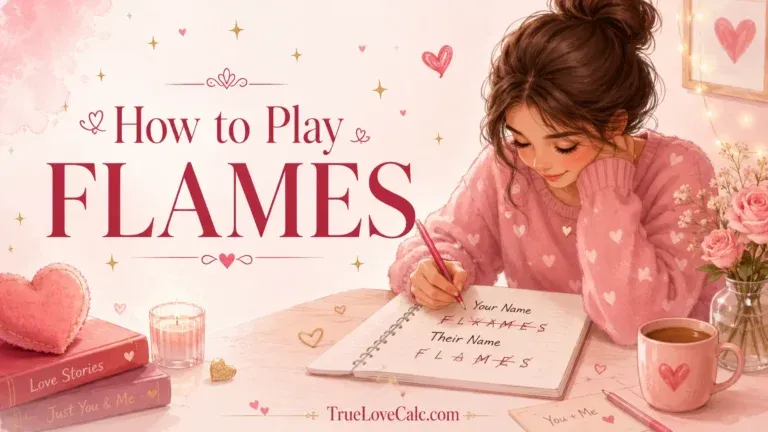
- Cancellation games. FLAMES crosses out shared letters and counts what’s left to land on Friends, Lovers, Affection, Marriage, Enemies, or Siblings. You can try it on our FLAMES calculator or learn the paper version in how to play the FLAMES game.
Here’s the honest part. None of these methods know anything about the two people behind the names. Spell a name differently, add a middle name, or use a nickname, and the score changes even though the relationship hasn’t. That’s why we label ours as entertainment, and why we wrote a whole article answering whether love calculators are accurate (short version: no, and that’s fine).
What a calculator can do is give you a playful excuse to talk. Typing in your names with a crush, laughing at a 23% score, and arguing that the math is clearly broken is a surprisingly good icebreaker.

Curious How Your Names Match?
Run your names through our free love calculator. It’s instant, it’s silly, and it’s 100% for fun. Your real compatibility is still up to you two.
💕 Try the Love CalculatorThe Final Verdict
Does your name affect your love life? A little, at the very start, and mostly through other people’s snap judgments. The name-letter effect is real, but it’s a quirk of self-liking, not a matchmaking force. The claim that we marry people with similar names made headlines, then ran into serious statistical criticism. The clearest evidence, from online dating, shows names can influence who clicks first, and even that depends on culture and on what a name signals in a particular place.
After the first click, your name fades into the background. What matters from there is the stuff no letter count can see: kindness, curiosity, humor, and how you handle a bad day together. If you’re getting to know someone new, our first date ideas will do more for your love life than any rename ever could.
Name and Love Life FAQs
Does your name actually affect your love life?
Slightly, and mainly at the first-impression stage. A large German online-dating study found that people with less-liked first names received fewer first profile visits. There’s no evidence that your name affects whether a relationship succeeds once two people actually get to know each other.
What is the name-letter effect?
The name-letter effect is people’s tendency to like the letters in their own name, especially their initials, more than other people like those letters. Jozef Nuttin first described it in 1985, and it has since been replicated across many languages and alphabets. It reflects self-liking, not a preference that reliably steers romantic choices.
Are people more likely to marry someone with the same initials?
A 2004 study of marriage records said yes. A 2011 reanalysis by Uri Simonsohn replicated the pattern but argued it was most likely explained by age cohorts, ethnicity, geography, and reverse causality, such as people from the same community sharing common surnames. The question is still debated, and any true effect would be very small.
Can a name make you more attractive?
Names can shift a first impression before someone sees you. Research shows easier-to-pronounce names are judged a little more favorably, and well-liked names got more clicks in one dating study. Once someone sees your photos or talks to you, those effects are swamped by everything else about you.
Is name compatibility real?
Not in the predictive sense. No study shows that two names, their letters, or their numerology numbers predict how well a couple gets along. Name compatibility tools are fun, but real compatibility comes from shared values, communication, and how you treat each other.
Can a love calculator by name predict compatibility?
No. A name-based love calculator turns letters into a number with a formula, so it only reflects spelling, not people. Ours gives the same score every time for the same two names, which makes it consistent but not predictive. Use it to spark a laugh or a conversation.
Should I change my name or use a nickname on dating apps?
Use the name you actually go by. If friends call you by a nickname, putting it on your profile is natural. Changing your name to game first impressions isn’t worth it, since the effect is small and fades the moment someone reads your bio or starts chatting with you.
Your Name Opens the Door. You Walk Through It.
A name gets a second of someone’s attention. Everything after that, from the first joke to the hundredth inside nickname, is written by the two people in the story. The letters are just the cover.
Sources
- Nuttin, J. M. (1985). Narcissism beyond Gestalt and awareness: The name letter effect. European Journal of Social Psychology, 15, 353–361.
- Hoorens, V. (2014). What’s really in a name-letter effect? Name-letter preferences as indirect measures of self-esteem. European Review of Social Psychology, 25, 228–262.
- Pelham, B. W., Mirenberg, M. C., & Jones, J. T. (2002). Why Susie sells seashells by the seashore. Journal of Personality and Social Psychology, 82(4), 469–487.
- Jones, J. T., Pelham, B. W., Carvallo, M., & Mirenberg, M. C. (2004). How do I love thee? Let me count the Js. Journal of Personality and Social Psychology, 87(5), 665–683.
- Simonsohn, U. (2011). Spurious? Name similarity effects (implicit egotism) in marriage, job, and moving decisions. Journal of Personality and Social Psychology, 101(1), 1–24.
- Pelham, B., & Carvallo, M. (2011). The surprising potency of implicit egotism: A reply to Simonsohn. Journal of Personality and Social Psychology, 101(1), 25–30.
- Gebauer, J. E., Leary, M. R., & Neberich, W. (2012). Unfortunate first names. Social Psychological and Personality Science, 3(5), 590–596.
- Laham, S. M., Koval, P., & Alter, A. L. (2012). The name-pronunciation effect. Journal of Experimental Social Psychology, 48(3), 752–756.